The case, chapter by chapter
0:00
How can a banned feature come back through a phone?
In October 2023, the U.S. International Trade Commission ruled that Apple had violated a trade law by importing watches that infringed two patents owned by Masimo, a medical technology company. It ordered those watches kept out of the country [2]. The feature at issue estimates the oxygen in your blood.
In March 2026, the Federal Circuit affirmed that ruling [1]. Yet in August 2025, Apple announced that blood oxygen was back on some models, "measured and calculated on the paired iPhone" [11].
Three questions run through the case. Who built the technology? What exactly was banned? And who won? Two details are often left out: five watches held at the Port of Chicago, and a jury award of $634,313,913 that came from a different patent [6][8].
0:58
Who built the technology, and what did Masimo claim in 2020?
A pulse oximeter shines red and near-infrared light through the finger. Blood that carries oxygen absorbs that light differently from blood that does not, and a detector reads the difference. Masimo was founded in California in 1989 [1].
In September 2020, Apple released the Apple Watch Series 6, starting at $399. On its back are four clusters of lights and four photodiodes. Apple said the readings were not intended for medical use [11].
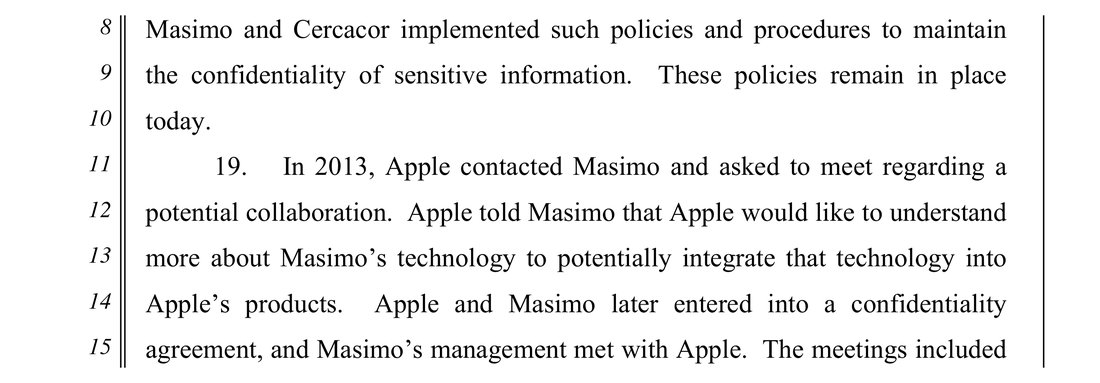
By then the two companies were already in court. In January 2020, Masimo and its co-plaintiff Cercacor had sued Apple in California. The complaint alleges that in 2013 Apple asked to meet about a possible collaboration, and that Apple then hired Masimo's chief medical officer and later the former chief technical officer of Cercacor [7]. Those are allegations in a complaint, and a court took more than six years to answer them.
Swipe sideways to read the full line.
2:09
Why did Masimo go to the International Trade Commission?
In June 2021, Masimo opened a second front at the Commission. The remedy it asked for was an import ban, not money [1].
The target was the Series 6 and two Masimo patents. They were filed in September 2020, nine days after Apple announced the watch, with a priority date going back to July 2008. The claims describe a device worn on the body, with sets of light emitters, four photodiodes, and a convex bump with openings over them [1].
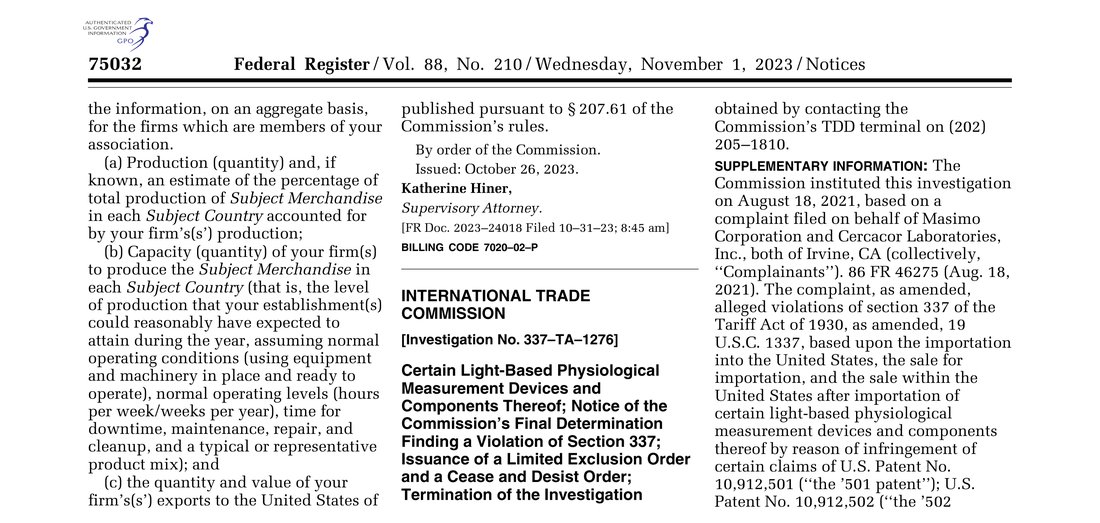
An administrative judge held a five-day hearing, heard 22 witnesses, and wrote 342 pages. In October 2023 the full Commission ruled that Apple had violated the law and issued a limited exclusion order [1][2].
Meanwhile, in California, the trade secret trial had ended on May 1, 2023 without a verdict, because the jury could not agree [12].
Swipe sideways to read the full line.
3:18
What did the White House review decide?
A president has 60 days to review an exclusion order. The job is delegated to the U.S. Trade Representative [5].
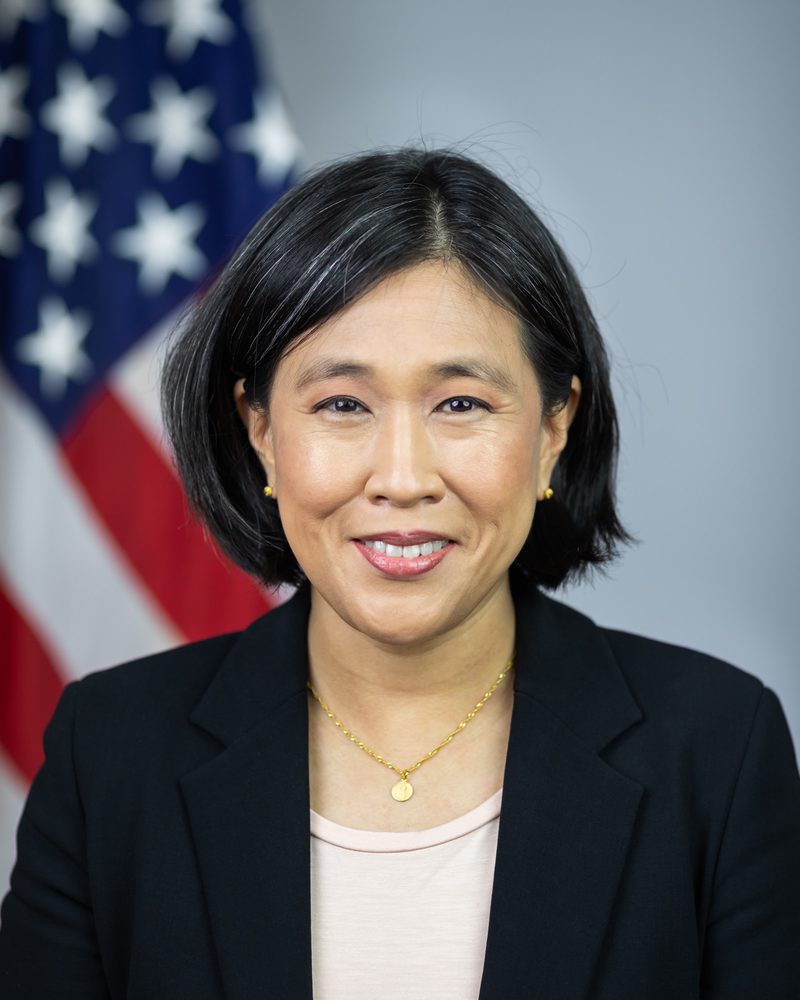
Press reports say Apple pulled the Series 9 and Ultra 2 from its website on December 21, 2023 and from its stores on December 24 [15]. The Trade Representative, Katherine Tai, decided not to reverse the decision, and it became final on December 26, 2023 [5]. Press reports say an appeals court paused the ban the next day and the watches came back. The pause lasted three weeks.
On January 12, 2024, Customs ruled that a redesigned watch could enter the country. The redesign was simple: the blood oxygen feature was switched off. According to the ruling, the watches kept the same pulse oximetry hardware [6]. From January 18, 2024, press reports say, new watches were sold without the feature, while watches people already owned kept it [15].
4:30
What is Redesign Two, and why were five watches held in Chicago?
Apple's answer reached Customs in March 2024. It was called Redesign Two. The watch would still shine the light and collect the signal, but the final calculation of blood oxygen would move from the watch to the iPhone [6].
In January 2025, Customs said no. It found that Apple had not shown the design did not infringe, and that the articles were "subject to the limited exclusion order" [6].
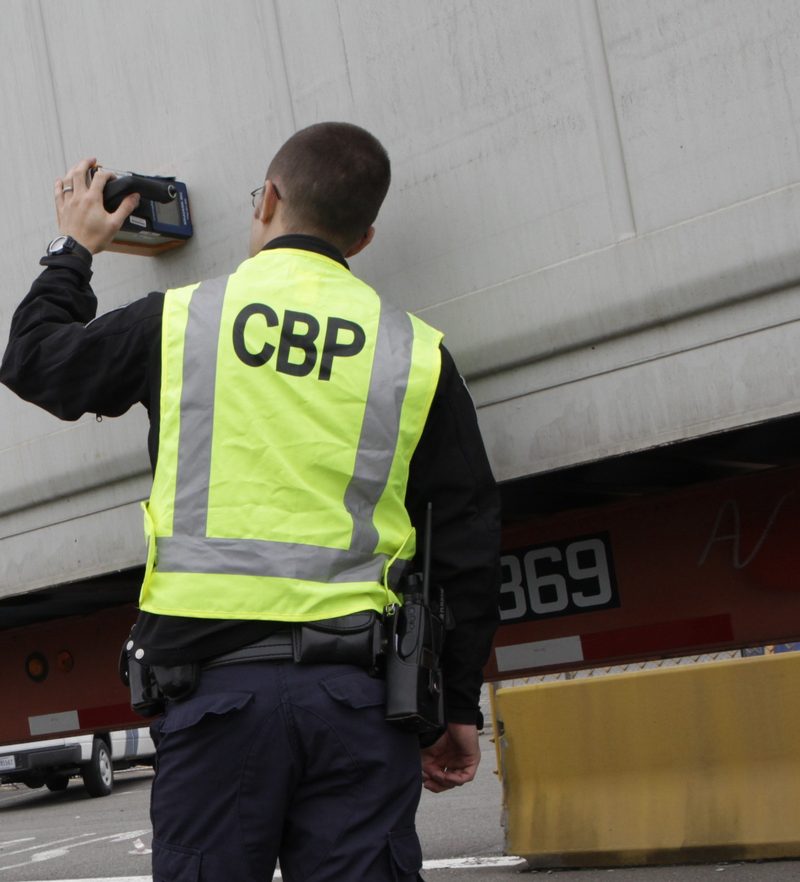
Then came the five watches. In July 2025, five Apple Watches built to Redesign Two were imported at the Port of Chicago and detained. Customs officers asked headquarters what to do. On August 1, the answer came back: imported alone, a watch does not meet every element of the patent claims, and the five watches "are to be released" [6].
Thirteen days later Apple announced that blood oxygen was back. Masimo says it learned of the ruling that same day, from Apple's announcement. It sued Customs, alleging the agency had "reversed itself without any meaningful justification" [9]. That is an allegation. And Masimo went back to the Commission that had issued the ban.

Swipe sideways to read the full line.
5:50
How did two decisions in two days leave the case open?
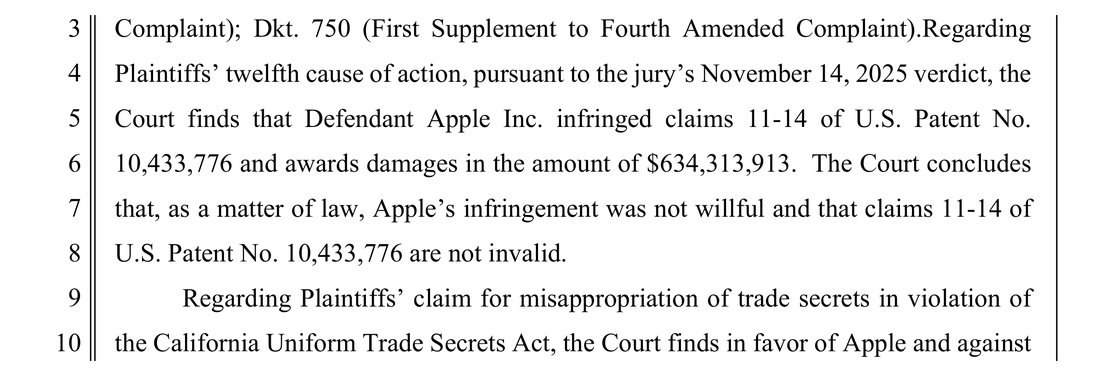
In November 2025 the Commission agreed to look at Redesign Two [3]. That same week in California, a jury finally delivered a verdict: Apple had infringed a Masimo patent, with damages of $634,313,913 [8].
Look at the patent number. It is not one of the two from the import case. It is an older patent, titled "Low power pulse oximeter," and its claims describe a patient monitor. The judge found the infringement was not willful. Apple told reporters the patent had expired in 2022, and press reports said it planned to appeal [8][15].
Then, in March 2026, came two decisions in two days. On the 18th, the Commission's judge found that the redesigned watches did not infringe. On the 19th, the appeals court affirmed the original ban [1][4]. Both are true at once: the first design is still banned, and the second one comes in. A month later the Commission declined to review its judge's finding and closed the proceeding [4].
Swipe sideways to read the full line.
7:15
Who is winning, Masimo or Apple?
Masimo has the ban on the original design, affirmed on appeal. Apple's own filing says it stays in place until August 2028 [10]. Masimo has the jury award, and its lawyers now put what Apple owes at more than $818 million [10].
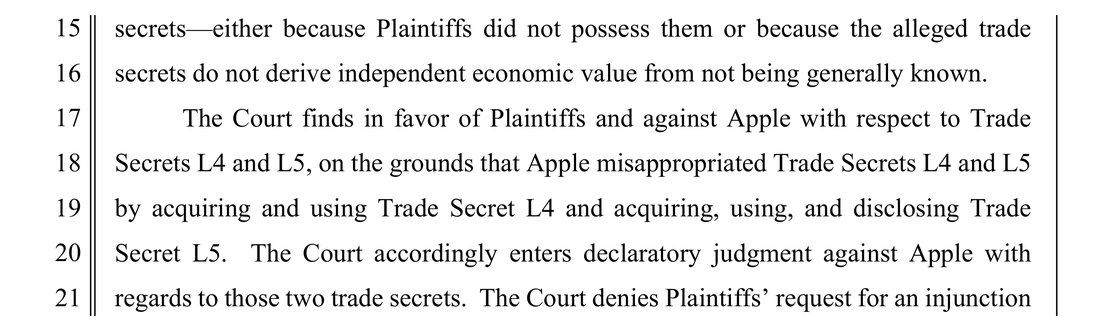
On the trade secret claims from the first complaint, the final judgment found that Apple misappropriated two of Masimo's trade secrets. It does not say what happened in 2013. On the other trade secret claims it decided, and on the claims over who owned certain patents, the court found for Apple. It refused an injunction, and it held that Masimo had waived, or was barred from, any money for misappropriation [8].
Apple has the feature back on some of its watches, and the Commission's finding on the redesign [4][11]. In a separate case Apple brought over Masimo's own smartwatch, a jury awarded Apple a total of $250, according to Masimo's quarterly report [12]. Both sides claim a win. Neither one is finished.
Swipe sideways to read the full line.
8:29
What is still open in Masimo v. Apple?
Masimo itself has changed. Its founder, Joe Kiani, gave notice of his resignation as chief executive in September 2024. In June 2026, Danaher completed its purchase of the company at $180 a share [12].
The California judgment is on appeal. In September 2026, Apple asked the Supreme Court to hear the import case. It argues that Masimo "barely sold" a product that used the patents. Masimo answers that Apple never presented its legal argument to the judge, the Commission, or the appeals court [10].
As of November 23, 2026, the Court has not said whether it will take the case. The order never banned an idea. It banned a design. The watch still shines the light, and the phone does the math.